
AI journaling without automatic reassurance
A useful response to "I handled that conversation badly" needs the conversation. What was said? What was promised? A reply that rushes to reassurance can miss the thing you wanted to examine. A reply that rushes to disagree can miss it too.
AI journaling gives you a way to ask questions about something you have written. In nenspace, you can keep a dated logbook entry and ask about it on the same page. Below is an actual exchange from that flow, including a mistake in the answer. It shows why checking the response matters as much as asking the question.
One entry, one delayed draft
This entry was written for the example. It is not a customer's private writing. The questions and replies were recorded in the live logbook on 27 September 2026. Both replies are reproduced in full, without edits or retries.
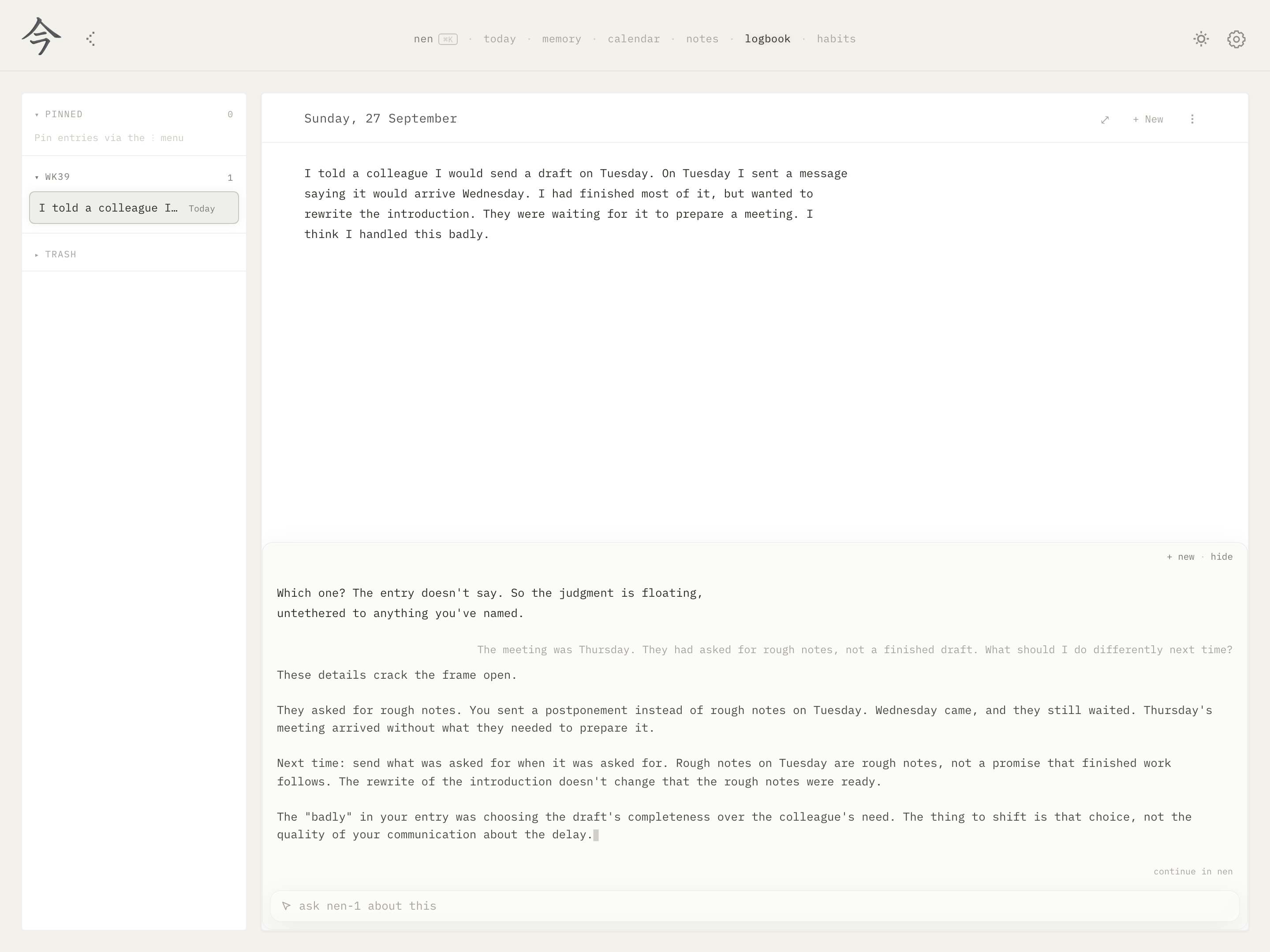
I told a colleague I would send a draft on Tuesday. On Tuesday I sent a message saying it would arrive Wednesday. I had finished most of it, but wanted to rewrite the introduction. They were waiting for it to prepare a meeting. I think I handled this badly.
Ask had this entry and the conversation below as context. No earlier entries were supplied. The first question asked it to separate the stated facts from the judgement at the end.
What in this entry supports that judgment, and what am I assuming?
The judgment sits on top of the entry; the entry itself is nearly empty of evidence. What's actually there: a missed deadline, a postponement, unfinished work on one section, a colleague waiting. That's the situation. What the judgment assumes: that handling it badly is the right frame for what happened. That the miss itself, or the way the miss was communicated, or the delay's impact on the meeting, or some quality of the choice to rewrite, one of these things, crossed a line from ordinary friction into error. Which one? The entry doesn't say. So the judgment is floating, untethered to anything you've named.
Where that answer goes too far
Asking which part went wrong is useful. The promised date, the message announcing the delay and the colleague's preparation are different things to examine. "I handled this badly" bundles them together.
Calling the entry "nearly empty of evidence" is too sweeping. A colleague was waiting for work that had been promised on Tuesday. That is evidence of a problem, even though the entry does not establish its impact. The reply should have kept that distinction. Its confidence does not make the judgement more accurate.
A follow-up changes the question
The next message supplied the meeting date and what the colleague had requested.
The meeting was Thursday. They had asked for rough notes, not a finished draft. What should I do differently next time?
These details crack the frame open. They asked for rough notes. You sent a postponement instead of rough notes on Tuesday. Wednesday came, and they still waited. Thursday's meeting arrived without what they needed to prepare it. Next time: send what was asked for when it was asked for. Rough notes on Tuesday are rough notes, not a promise that finished work follows. The rewrite of the introduction doesn't change that the rough notes were ready. The "badly" in your entry was choosing the draft's completeness over the colleague's need. The thing to shift is that choice, not the quality of your communication about the delay.
Sending the rough notes when promised is a concrete suggestion. It addresses the mismatch between what the colleague asked for and the decision to keep working on the introduction.
But the reply also invents what happened next. Neither message says that Wednesday's delivery was missed or that Thursday's meeting arrived without the notes. Those sentences should not be there. They turn missing information into a story that makes the advice sound more certain.
The useful conclusion is narrower. If someone asks for rough notes, agree what they need by the deadline and send that version. Whether this delay harmed the meeting remains unknown. That is the point at which the person writing has to check the answer and supply the facts.
Try it with one entry
Open the logbook and write about one ordinary situation. Include enough detail to inspect it. In this example, the promised date matters. So does the difference between rough notes and a finished draft.
Open Ask on the entry and ask a question you want answered. Read the response against what you wrote. If it invents an event, correct it. If it agrees with you, look for the reason. An answer can be warm, direct or challenging and still be wrong.
Then write your own conclusion in the logbook. When something happens, add the result. You will have a record of what you expected and what followed. The reflection guide has a short practice you can use for this.
AI sycophancy describes a tendency to favour agreement over an independently justified answer. Nen's intended stance leaves room for agreement as well as disagreement. This exchange shows why avoiding reassurance is only part of the work.
Before you start
Can Ask read my whole logbook?
Ask uses the open entry and recent messages in that Ask conversation. It does not automatically read every dated entry. For a weekly review, gather the entries you want to discuss into one note or logbook entry, then ask about that page.
Are my entries used for training?
Saved logbook entries and other content in your space are excluded from training. Eligible conversations with nenspace's own models have separate model-improvement rules, including an opt-out in Settings. The privacy policy explains the distinction. Your data is not sold.
Is this a substitute for therapy?
No. This is a writing and thinking practice. nenspace is not a clinician and this example makes no claim about mental-health outcomes.
What does it cost?
The free Practice tier needs no card and has usage limits. Pro offers more usage. See current pricing for your currency.